

NJT Tax Return Manager

(Bridging software for online filing of the MTD compliant Tax Returns to Her Majesty's Revenue and Customs)

How to Install on your Computer & Configure Microsoft Access


How to Install

[Click here] Before you install, it is recommended that you view the 'System Requirements' page.

  1. Create New Folder
    Always create a new folder on your local computer. For example, "C:\My Tax Returns". You will later download the 'NJT Tax Return Manager' into this folder. This is known as the 'Front End' database or 'Front End' software.
    When you first open the software, it creates a default 'Back End' database within the sub folder '/(Database)'. If you wish, you may move this 'Back End' database to a different folder. For example, on an authentic Network Drive etc.
    For information, OneDrive, Google Drive, DropBox etc. should not be used as they are 'File sharing' folders, not authentic Network Drives.

    Tip: You may wish to create a shortcut on your Windows Desktop, which points to this local folder. Note: The actual file name of the 'Front End' software will change when subsequent versions are released, so the shortcut needs to point to the Folder and not the file.

  2. Full Access Installation - Change Access Configuration (Options/Trust Centre)
    If Microsoft Access is already installed on your computer as part of Microsoft Office, then apply the following configuration changes.
    In order for the 'NJT Tax Return Manager' to function correctly, a few changes are required within the Access Options.
    1. Open Access. Then click on 'Options' (Bottom left of screen), then click on 'Trust Centre' then click on 'Trust Centre Settings'
    2. Trusted Locations: Add the 'Location' of the folder where you saved the Tax software,
      (For example, "C:\My Tax Returns"). Also tick the box 'Subfolders'.
    3. ActiveX Settings: Select the round radio button 'Prompt me before enabling all controls with minimal restrictions'.
    4. Macro Settings: Select the round radio button 'Disable all macros except digitally signed macros'.
    5. Then, click on the 'OK' button.
    6. Finally, Exit Access.

  3. Microsoft 365 Access Runtime Version
    If Microsoft Office is not installed on your computer then you can download the Microsoft 365 Access runtime version free of charge.

    If your current Office installation does not include Microsoft Access then you can also download the Microsoft 365 Access runtime software free of charge. In which case, Microsoft will attempt to download the corresponding version of the RunTime software. For example Office 2024 & Access Runtime 2024.

    Important Note: The Runtime software must match the architecture of your Microsoft Office.
    Example 1: If Office 64-bit is installed then you must download Access Runtime 64-bit.
    Example 2: If Office 32-bit is installed then you must download Access Runtime 32-bit.

    Click on the link below to download Microsoft Access 365 Runtime then continue at the next step.
    Remember to select the 'English' language option from the dropdown menu.
    [Click Here] to goto the Microsoft Access Runtime Download Page.

  4. Add the NJT Website address to your list of Trusted Sites (Internet Options/Security/Trusted Sites/Sites)
    Microsoft has taken a much tighter approach to software security when downloading software. In order for the 'NJT Tax Return Manager' to function correctly, please add the NJT website address to the list of 'Trusted Sites' within your Windows 'Internet Options'.
    Your Internet Options can be found via the 'Control Panel' or by typing "Internet Options" within your Windows search box.
      Within your Internet Options:
    1. Click on the 'Security' tab.
    2. Click on the 'Trusted Sites' Zone.
    3. Click on the 'Sites' button.
    4. Type "https://neilsonjamestech.co.uk/" in the box. (Excluding the speech marks)
    5. Click on the 'Add' button.
    6. Also tick the box named 'Require server verification (https:) for all sites in the zone'.
    7. Then click 'Close' followed by 'OK'

  5. Download Software to Folder
    Microsoft has taken a much tighter approach to software security when downloading software.
    The file that you download from the NJT website is 'NJT Tax Return Manager Vx.accdc', which is a 'Microsoft Access Signed Package' file. Meaning it contains an official Digital signature verified by a trusted Certificate Authority (CA), namely, Sectigo.
    You then extract the actual software by opening the package file, it is essentially a 2-step process.

    Access Security Notice Download the Signed Package file (via the button below), then (move or save) it to the folder you have just created.

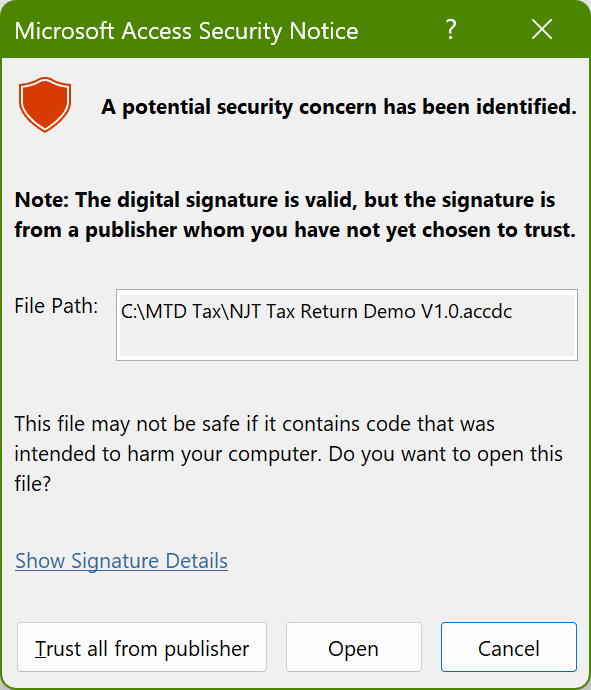
    Once saved, open the file. It may display the 'Microsoft Access Security Notice' message. If so, just click on the 'Trust All from Publisher' button.
    Note: prior clicking on the above button, you may 'Show the Signature Details'.
    You will then be asked to save the extracted 'NJT Tax Return Manager Vx.accdb' file. Just save this file to the same folder.

    Note 1: The download process may vary depending upon which Internet browser you use and the browser's configuration.
    Note 2: It is important that you store the software within it's own folder as certain sub folders are automatically created when the software is opened.

    Click on the button to download the software.

  6. Open Software
    Finally, Open the 'NJT Tax Return Manager Vx.accdb' software and follow the on-screen instructions.
    You can then click on the 'User Guide' button located on the righthand side of the Dashboard window.

  7. Free Remote Support from NJT
    If you are having difficulties installing the software, then you can contact NJT and arrange for assistance via the 'Remote log-in' service.
    1. Contact NJT and arrange a time.
    2. [Click Here] to download the 'Splash Top' SOS software.
    3. Run the software, then telephone NJT and give the 9-digit code when requested.
    4. NJT will then remotely access your computer.
    5. When the remote access session is complete, disconnect then exit the software.


Introduction: Files created by this software are organised using a pre-set folder structure. Sub folders are created automatically within the folder where the workbook resides. It is recommended that the ‘Tax Return Manager’ software is stored in a specific folder. For example, "C:\My Tax Returns".

Database Folder: When you first use the software, a ‘Back End’ database is created within the sub folder ‘(Database)’. You may then move this database to a different location. For example, where you wish to store the database in a folder on a Server.

Import Folder: When you Import a V'AT Return' or 'Quarterly Update' from, for example an Excel workbook, the routine first searches in the sub folder '(Import)'. This may be a convenient location to store the files. However, For each Taxpayer, the file folder location is saved automatically after each import, therefore you can essentially store the files in any accessible location. This folder location then becomes the default for future imports.

Receipt Files: When a draft or finalised VAT Return or an Income Tax ‘Quarterly Update’ is saved as a PDF file it is stored, by default, to the sub folders ‘(VAT Documents)’or ‘(IT Documents)’ respectively. However, for each Taxpayer, the folder location can be changed, essentially allowing you to store the PDF Receipts in any accessible location. Once changed, the new folder location becomes the default for that Taxpayer.

VAT Return Evidence Files: During each VAT Return submission, copies of the full submission and HMRC response are saved to the sub folder "Evidence". These files are stored in Text and JSON format and can be viewed using a 'Text' editor such as NotePad or WordPad.

Archive Folder: After you have transferred to a new release of the software you may wish to move your old version into the '(Archive)' folder to avoid confusion as to which is your latest software version. In practice, as all ‘Business Critical’ data is stored within the separate database, old versions can be deleted.

Backup History Folder (Stores 'Back End' Database Backups): You can backup the ‘Back End’ database to a sub folder ‘(Backup History)’ located within the current database folder.

Logs and Bin Folders: The sub folders "(Bin)" and "(Logs)" are used to store technical log files created by the software. These log files may assist in the resolution of technical issues that may occur during the use of the software.